Understanding Problem Gambling
How do gambling problems develop and change over time?
Research suggests that gambling problems often develop through predictable emotional and behavioral stages. While every individual’s journey is unique, common patterns of development can help inform prevention and treatment strategies. 5
The Winning Stage
This stage often begins with early wins that create excitement, build confidence, and lead to a belief that gambling is a real way to earn money. Individuals may bet more often, wager higher amounts, and start to view gambling as a skill-based activity rather than as chance.
The Losing Stage
As losses begin to add up, gamblers may start “chasing losses” in order to win back money. Denial, the need to borrow money, and secrecy increase during this phase. Gambling may become more frequent and impulsive, and the person begins to feel the financial and emotional strain their gambling has caused.
The Desperation Stage
The person experiences growing negative consequences—such as debt, relationship conflict, and employment or school problems—but continues to gamble to escape distress or recover losses. Feelings of shame, isolation, and anxiety build, and the gambler may be tempted to engage in illegal behavior (e.g., theft, fraud) to pay for gambling-related costs.
The Hopeless Stage
In this stage, the individual may experience a loss of control, severe depression, or suicidal ideation. There is often a sense that recovery is impossible, and the person may feel completely trapped by the financial, relational, and emotional consequences of their gambling behavior.
A Common Pattern, Not the Only Path
These stages are based on a commonly used model of how gambling problems can develop over time. They help illustrate how early wins can gradually evolve into serious harm.
While many people with gambling problems pass through some or all of these stages, not everyone’s experience will look the same. Some individuals may move quickly between stages, skip a stage, or seek help at any point in the process.5
How common is problem gambling in the U.S?
National trends provide a helpful lens for understanding how gambling behaviors evolve and where risks may emerge. Findings from the National Council on Problem Gambling show that millions of adults nationwide experience gambling-related challenges, offering important context for what we see here in Kentucky.18
PROBLEM GAMBLING ALERT
8%
of U.S. adults reported experiencing at least one indicator of problematic gambling behavior “many times” in the past year.18
≈20 million people affected
Key Risk Indicators
National Young Adult Trends
A National Collegiate Athletic Association (NCAA) survey in 2023 found that many young adults are engaging in sports betting at high rates. 17
Young Adult Trends
Ages 18–22
58%
have wagered on sports
College Students
On college campuses
67%
have wagered on sports
Among Sports bettors
Young adults who bet on sports
16%
report at least 1 risky behavior
How common is problem gambling in Kentucky?
While most Kentuckians who gamble do so without serious harm, state estimates indicate that tens of thousands of adults—and thousands of college students—are experiencing gambling at levels that negatively affect their lives. Many face financial strain, relationship conflict, or disruptions to work and school as a result of gambling-related problems.9
At the same time, gambling opportunities and revenues in Kentucky have expanded rapidly, particularly through sports betting, mobile wagering, and historical horse race–based gaming devices.2 These activities generate substantial income but are also associated with significant social costs, including financial distress, health impacts, lost productivity, and criminal justice involvement, as well as rising demand for help. In the state there are only 5 certified gambling counselors, leaving a gap between the level of harm and the availability of specialized treatment.22,10
STATE LEVEL ANALYSIS
Local data highlights the rapid adoption of sports betting and rising concerns.
SPORTS BETTING REVENUE
$2.39B
HORSE RACING REVENUE
$6.8B
In 2022, historical horse racing generated $6.8 billion, a 47.8% increase from the previous year. By February 2023, revenue had already reached $693 million — up $119 million compared to February 2022.25
LOTTERY SALES RECORD
$2.156B
In 2025, Kentucky Lottery sales reached $2.156 billion, setting a record and reflecting continued high participation across the state. Lottery games remain widely accessible and account for a substantial share of overall gambling activity in Kentucky.14
SOCIAL COSTS
$500M
Estimated annual social costs in Kentucky related to gambling addiction, including bankruptcy, healthcare utilization, lost productivity, and criminal justice involvement. 22
According to the April 2024 NGAGE 3.0 survey by the National Council on Problem Gambling, approximately Kentucky adults reported, 19
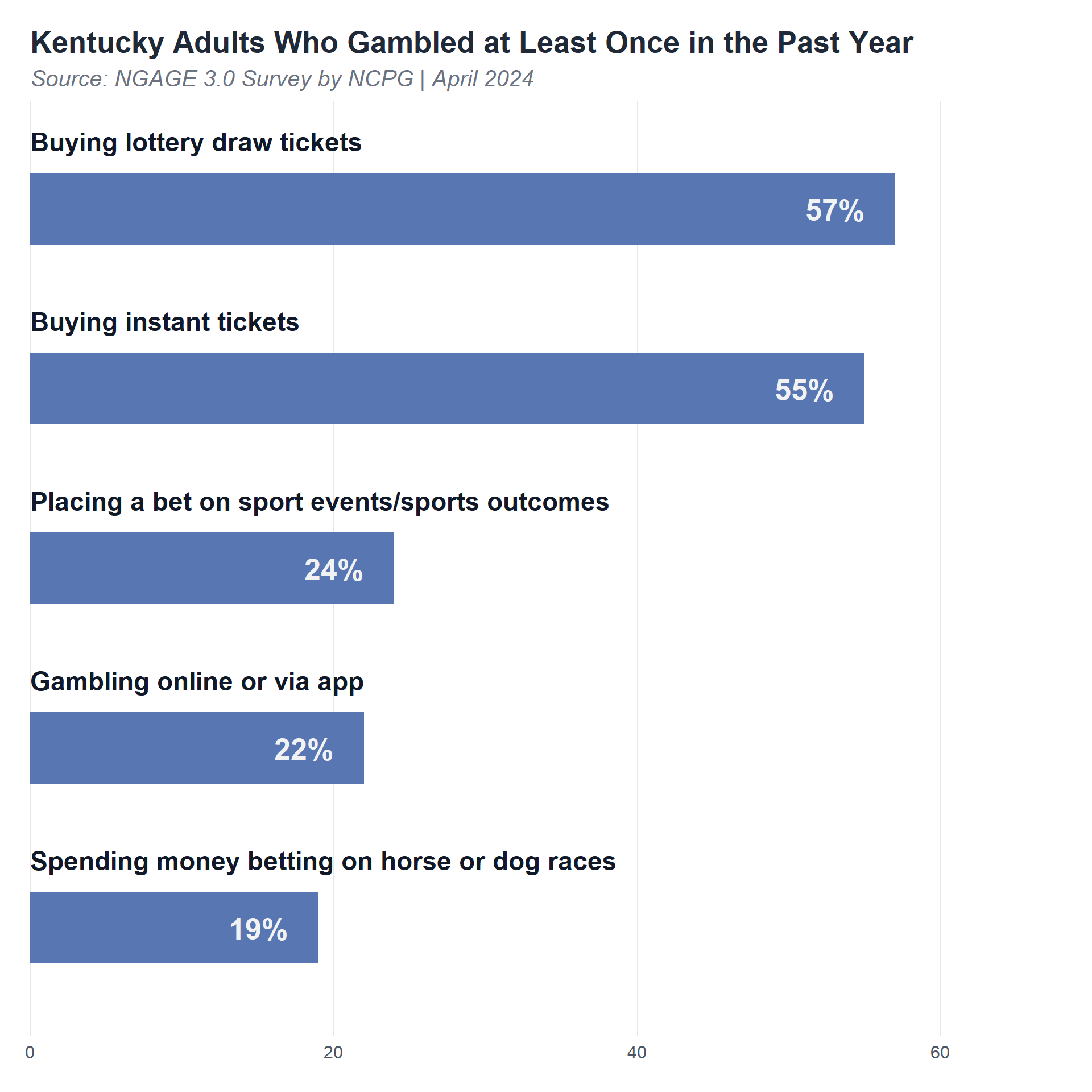
Source: NGAGE 3.0 Kentucky Specific Data
Who is most at risk of problem gambling?
Certain groups in Kentucky are disproportionately affected by gambling problems:
Youth and Adolescents
The most recent Kentucky Incentives for Prevention (KIP) statewide survey, administered to more than 21,000 public school students in 109 districts in fall 2024, found that over 20% of high school seniors reported having gambled for money or possessions during their lifetime. Across all grade levels surveyed (6th, 8th, 10th, and 12th), nearly 2% of students reported that gambling had led to financial problems or problems with family, school, work, or personal life behaviors consistent with gambling addiction. Early exposure to gambling in family or peer settings increases the likelihood of developing lifelong problems.8
College Students
An estimated 9,000–15,000 Kentucky college students meet the criteria for gambling addiction. National NCAA research shows that college students—especially athletes—are significantly more likely to engage in risky sports betting and online gambling compared to the general population.17
Justice System-Involved Individuals
People who are on probation, parole, or in correctional facilities show much higher prevalence of problem gambling than the general adult population, with as many as 15,000 Kentuckians in this category affected.9
Young Men, Especially Those Betting Online
The 2024 NGAGE 3.0 survey found that being male and under 35 is one of the strongest predictors of gambling risk. A total of 15% of adults ages 18–34 reported concerning behavior, compared to 2% of those 55+. This reflects broader national trends showing that young men, particularly those engaged in online, and sports betting are disproportionately vulnerable to problem gambling.18
People With Mental Health or Substance Use Concerns
Problem gambling rarely occurs in isolation. Research shows strong connections between gambling addiction and other behavioral health challenges, and individuals with a history of mental health or substance use concerns are at increased risk of developing gambling problems.20
How can someone prevent themselves from developing a gambling problem?
Understanding personal risk factors and warning signs is the first step toward preventing problem gambling. In general, these are great strategies to support a person’s well-being.
Strategies to Help Prevent Gambling Problems
Understanding mental health and substance use patterns is an important part of preventing gambling-related harm. Being aware of symptoms—such as anxiety, depression, impulsivity, or substance use—can help an individual recognize when gambling may worsen these concerns or become a coping mechanism.
When a client is informed about their mental health it gives them the ability to make safer choices and seek support early if needed.
Engaging in positive, meaningful activities can reduce the amount of time spent gaming or gambling and improve overall well-being.
Examples include:
- Exercise or outdoor recreation
- Reading or creative hobbies
- Journaling or mindfulness practices
- Social activities that strengthen connection
These activities help support balance, stress management, and healthier routines.
Routine screening for gambling-related concerns is recommended in behavioral health, primary care, and other appropriate settings to support early identification. If an individual is exhibiting signs of gambling-related concerns, timely referral for further assessment by a qualified professional is advised.
Screening can help clients:
- Understand their level of risk
- Identify early warning signs
- Learn about helpful next steps or resources
Screening is confidential and a valuable first step in reducing harm.
Tips for Gambling Responsibly 6
Responsible Gambling Strategies
Clinicians can encourage individuals who choose to gamble to adopt harm-reduction strategies, including
- Establishing limits in advance – Setting predetermined time and monetary limits prior to gambling and adhering to those limits.
- Maintaining an entertainment mindset – Framing gambling as a form of paid entertainment rather than a source of income or financial strategy.
- Recognizing the role of loss – Understanding that losses are inherent to gambling and ensuring that any expenditures remain within a discretionary entertainment budget.
- Maintaining life balance – Monitoring for impacts on relationships, employment, or daily responsibilities, and taking planned breaks from gambling when it begins to interfere with other areas of functioning.
High-Risk Gambling Behaviors
Clinicians should assess for and address the following behaviors, which are associated with elevated risk for gambling disorder:
- Using borrowed or essential funds to gamble – Gambling with money allocated for savings, bills, or borrowed from others may indicate impaired financial boundaries and increased risk.
- Chasing losses – Attempting to recover lost money through continued gambling often leads to escalating financial harm and loss of control.
- Viewing gambling as a source of income – Treating gambling as a financial solution or “quick cash” strategy reflects distorted expectations and increases vulnerability to problematic behavior.
- Using gambling as an emotional coping strategy – Engaging in gambling to manage stress, distress, loneliness, or physical pain may reinforce maladaptive coping patterns and contribute to disorder progression.
References
- American Gaming Association. (2024, August). Regulatory vigilance critical to ensure “sweepstakes” don’t threaten consumers and undermine gaming regulation [PDF]. Legal Sports Report. https://www.legalsportsreport.com/wp-content/uploads/2024/08/AGA-Sweepstakes-Memo-1.pdf
- American Gaming Association. (2025). State of Play: Gaming map and legal landscape. https://www.americangaming.org/research/state-of-play-map/
- American Psychiatric Association. (2022). Diagnostic and statistical manual of mental disorders (5th ed., text rev.).
- Blaszczynski, A., & Nower, L. (2002). A pathways model of problem and pathological gambling. Addiction, 97(5), 487–499.
- Custer, R. L., & Milt, H. (1985). When Luck Runs Out: Help for Compulsive Gamblers and Their Families. Facts on File.
- Evergreen Council on Problem Gambling. (n.d.). Responsible gambling guidelines. Retrieved November 5, 2025, from https://www.evergreencpg.org/responsible-gaming/responsible-gambling-guidelines/
- Gambling Industry News. (2025). U.S. Lottery – A state-by-state guide. GamblingIndustryNews.com. https://gamblingindustrynews.com/usa-lottery/
- Kentucky Center for Statistics. (2024). Kentucky Incentives for Prevention (KIP) statewide report. https://www.kipsurvey.com/kip-reports-publications
- Kentucky Council on Problem Gambling. (2022). By the numbers: Kentucky gambling behavior, prevalence, and treatment estimates. https://kycpg.org/wp-content/uploads/2022/09/By-the-Numbers.pdf
- Kentucky Council on Problem Gambling. (n.d.). Referral resources for individuals and families. Find a Counselor – Kentucky Gambling Help
- Kentucky Department of Charitable Gaming. (2024). Licensing and Regulations. https://dcg.ky.gov
- Kentucky General Assembly. (2023). House Bill 551 (Regular Session). Bills - Legislative Research Commission
- Kentucky Horse Racing Commission. (2024). Pari-Mutuel Wagering Overview. https://khrc.ky.gov
- Kentucky Lottery Corporation. (2025). Fiscal Year 2025 annual report. https://klcannualreport.my.canva.site/fy25
- Legal Sports Report. (January 5, 2026). US Sports Betting Revenue & Handle. https://www.legalsportsreport.com/sports-betting-states/revenue/
- Let’s Gamble USA. (2024). Kentucky gambling laws & legal age to gamble. Let’s Gamble USA. https://www.letsgambleusa.com/kentucky/gambling-laws/
- National Collegiate Athletic Association. (2023, May). Sports wagering survey of 18–22 year olds. NCAA Media Center. NCAA releases sports wagering survey data - NCAA.org
- National Council on Problem Gambling. (2024). NGAGE 3.0 Key Findings. Washington, DC: National Council on Problem Gambling. https://www.ncpgambling.org/wp-content/uploads/2025/06/NGAGE-3.0-Key-Findings-FINAL-FOR-DISTRIBUTION.pdf
- National Council on Problem Gambling. (2024). NGAGE Survey Dashboard. Retrieved from https://www.ncpgambling.org/training/ngage-survey/ngage-dashboard/
- National Council on Problem Gambling. (2025). Problem Gambling Fact Sheet. https://www.ncpgambling.org/wp-content/uploads/2025/01/PGAM-2025-Problem-Gambling-Fact-Sheet.pdf
- New York Council on Problem Gambling. (2023, August). Sports betting glossary of terms. https://nyproblemgambling.org/wp-content/uploads/2023/08/Sports-Betting-Glossary-of-Terms.pdf
- NKyTribune. (2025, January). Kentucky Council on Problem Gambling sees increase in helpline calls amid greater awareness. NKyTribune. https://nkytribune.com/2025/01/kentucky-council-on-problem-gambling-sees-increase-in-helpline-calls-amid-greater-awareness/
- Responsible Gambling Council. (n.d.). What is gambling? Responsible Gambling Council. https://responsiblegambling.org/for-the-public/about-gambling/what-is-gambling/
- SweepCasinos. (2025). Sweepstakes casinos in Kentucky: Free online casino play. https://sweepcasinos.com/state/kentucky
- USA Casinos. (2024). Kentucky Casinos. https://usa-casino.com/usa-casinos/kentucky-casinos/